If you’re already a pro on the subject of filter bags (socks) you can click right on through to our products and specifications pages where you’ll find everything you need for filtration. But you might want to stick around and pick up some important information right here.
If you produce or work with foods, paints, coolants, lubricants, or other industrial liquids, liquid filtration is vital to your production processes and critical to your product integrity. Stray particles can damage equipment and compromise quality. The right filtration will minimize contaminants, so your choices are super important.
Here are some important things we need to know to help you get the Right filter:
What’s the product that needs filtration?
Viscosity
Flow rate
Temperature
Amount and size of particles, dirt, and debris to be filtered
As if that wasn’t enough, not all filter bags are created equal. These are the main considerations:
Micron rating
Filter media
Filter construction
Filter Life and Reusability
Filter bags are usually specified by micron size. A micron is one-millionth of a meter (that’s REALLY tiny). To put that smallness into perspective, a human hair is anywhere from 40 to 90 microns in diameter, and particles less than about 25 microns are invisible to the eye. A common bacteria, like e.coli, measures about 1x2 microns.
MICRON RATINGNominal micron rating is the pore size that retains the majority of particles at 85% of the rated pore size. Absolute micron rating is the pore size means that 95-99% of particles over a given micron value will be removed.
But, remember that process conditions like operating pressure and concentration of contaminant significantly affect filtration efficiency.
5 Micron - Removes a large amount of debris from liquid. You can even get down to a one-half micron rating, but filters below 5 micron are prone to intense clogging or quick debris buildup. A 5 micron rating works well in many industries, including the food and beverage industry.
10 Micron – These filters remove a lot of unseen materials from liquid but not bacteria or viruses. Still, 10 micron is still very small and can benefit many industries, from oil to chemical plants, because of their ability to filter so much. Like the micron ratings lower than this, 10 micron rated filters tend to clog more quickly.
25 Micron- Filters out anything larger than the size of a white blood cell. They work well in chemical processing industries, offering a balance between their ability to filter small particles without clogging badly, with emphasis on particle size. When paired with other filters they’re even more effective.
50 Micron - A rating of 50 micron is often the ideal balance between filtration and clogging. They remove only particles that can be seen with the human eye. Still, this rating is able to filter debris the size of the diameter of human hair and larger. The main benefit for this micron rating is that it filters a lot from liquid without the clogging issues that come with lower micron-rated filters. The versatility of this rating makes it popular in many industries.
Plus even more sizes:200, 400, 600, and 800 micron liquid filter bags
Don’t over-specify! When it comes to micron ratings, the old “if a little is good, then more is better” simply doesn’t work. It’s really important not to over-specify the micron rating – it won’t necessarily be better for your process. Why? The smaller the micron rating, the faster the filter fills up. If your application involves a broad range of particle sizes, or a large volume of dirt and debris, it’s better to use more than one filter to prevent clogging.
FILTER MEDIA TYPES
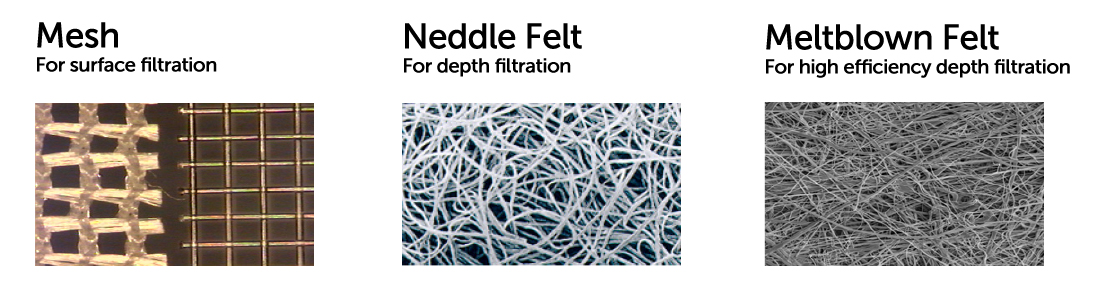
Feltprovides excellent depth filtration at low cost. It’s dense yet highly permeable to allow greater dirt holding capacity, but they can’t be cleaned for reuse. Needlefelt media comes in 1-200 micron grades. Meltblown felt media offers high efficiency filtration in the 1-25 micron range.
Mesh filter bags filter at their surface in 1-1500 micron grades, making them good for larger solid particles, and they’re generally washable. Multifilament mesh is constructed of many tiny filament yarns twisted together and then woven or knit. Monofilament mesh is constructed of precisely woven single filament yarns. It’s generally more expensive than the other media materials, offering both high strength and reusability.
Felt filter bags are commonly made from either polyester (PES) or polypropylene (POG). Polyester bags will operate at temperatures up to around 275o F with micron ratings up to around 500. Polyester felt is the most economical option for metal working fluids. Polypropylene has broad chemical compatibility, and will operate at temperatures up to about 200o F with micron ratings up to around 500. Polypropylene’s increased range of chemical compatibility allows it to be used in almost any industrial liquid.
Felt filter bags are also available in Teflon® (PTFE) for critical chemical applications and temperatures to 500 o F, and Nomex® (HT), best for high strength applications at temperatures to 375o F. Nylon mesh bags are a good choice for larger particle sizes (up to around 1200 microns) and higher temperatures..
HIGH EFFICIENCY FILTERS
Microfiber bags combine layers meltblown felt media with a microfiber layer to provide high filtration efficiency at low 1-50 micron ratings. Polypropylene “500 Series” filters use multiple layers of polypropylene microfiber to deliver absolute efficiency of up to 99% at micron ratings from 1-32. They also absorb oil at 15-25 times their own weight.
FILTER CONSTRUCTION
Sewn seam bags are the lowest cost filter bags available. As the name implies, the seams are sewn with polyester or polypropylene thread.
Welded seam bags have thermally welded seams. This construction provides much higher seam strength with no loose threads or the possibility of unfiltered liquid bypassing through the needle holes found on traditional sewn bags.
All BASCO bags are available with one-piece polypropylene rings/flanges, or carbon steel, galvanized steel, stainless steel, even titanium. All bags are available with a heavy duty handle that makes bag replacement faster and easier.
A Final word (or two) about filter bags: your application is special and unique – let us put our knowledge and application experience to work for you. Make BASCO your choice for filtration supplies and make a difference in your product and process quality. Call us at 1-800-776-3786.